Join us at Oracle Open World 2010 for a session on "Sales and Operations Planning for the Food and Beverage Industry"
http://www.eventreg.com/cc250/sessionDetail.jsp?SID=315911
Monday, August 9, 2010


Friday, June 18, 2010
Oracle E-Business Suite, Virtualization and Cloud Computing
Oracle E-Business Suite, Virtualization and Cloud Computing
Oracle E-Business Suite, Virtualization and Cloud Computing
New and Valuable Capabilities in this Oracle Release
February 3, 2010,
Volume 144, Issue 1

New and Valuable Capabilities in this Oracle Release
February 3, 2010,
Volume 144, Issue 1
 Oracle E-Business Suite 12.1.1 in a five-part nutshell. Oracle E-Business Suite 12.1.1 in a five-part nutshell.  |
In a five-part series on virtualization and cloud topics, Ivo Dujmovic, an architect in Oracle's Applications Technology Integration group, offers a detailed view of the Oracle E-Business Suite 12.1.1 for prospective and current users.
Read the complete article by clicking on this link "Oracle E-Business Suite, Virtualization and Cloud Computing"
Friday, April 16, 2010
Cloud Computing

Definition:
As defined by NIST(national institute of technology) Cloud computing is essentially on demand access to computing resources.
It has essential characterstics of on demand self service, resource pooling, rapid elasticity to scale out and scale in, the ability to meter who is using what and broad network access.
Three service models for cloud computing are:
1. SaaS software as a service, is a prebuilt, vertically integrated application/solution delivered to customer as a service.
2. IaaS infrastructure as a service, is purely providing computing resources, storage and network, as service to the client.
3. PaaS platform as a service. is a flexible combination of above two service models and thus customer can develop and deploy their own application using best of both the worlds.
It has essential characterstics of on demand self service, resource pooling, rapid elasticity to scale out and scale in, the ability to meter who is using what and broad network access.
Three service models for cloud computing are:
1. SaaS software as a service, is a prebuilt, vertically integrated application/solution delivered to customer as a service.
2. IaaS infrastructure as a service, is purely providing computing resources, storage and network, as service to the client.
3. PaaS platform as a service. is a flexible combination of above two service models and thus customer can develop and deploy their own application using best of both the worlds.
Deployment models:
1. Public cloud, is shared across multiple customers or tenants and is hosted and managed by a service provider.
2. Private cloud on the other hand is exclusive for an organization and is controlled and governed by that organization.
3. Hybrid cloud is where an organization with a private cloud model uses public clouds for any excess cloud service requirements occassionally. Eg an overflow or for additional workload needs
4. Community cloud is a semi private cloud with access to only a set of defined tenants who share backgrounds or needs
What is driving clouds ?
1. Public cloud, is shared across multiple customers or tenants and is hosted and managed by a service provider.
2. Private cloud on the other hand is exclusive for an organization and is controlled and governed by that organization.
3. Hybrid cloud is where an organization with a private cloud model uses public clouds for any excess cloud service requirements occassionally. Eg an overflow or for additional workload needs
4. Community cloud is a semi private cloud with access to only a set of defined tenants who share backgrounds or needs
What is driving clouds ?
AGILITY AGILITY AGILITY
The fact that users can provision resources on demand, acquire more resources when needed and release them when done with them, is the key driver for cloud computing.
Any drop off which may occur in the interaction happening between two clouds, might just mean a complete loss of valuable services. It is like two clouds up in the sky and informatiin flashin like lightening going from cloud to cloud and cloud to ground, the possibiltiess of loss of energy is inevitable and that is where the core problem of cloud computing lies.
Amazon web services are already in this niche market. For a public cloud to become a feasible solution for small businesses, the need to ensure the security of transaction and data.
Google OS is another such initiative where we will see a huge participation and usage of cloud computing capabilities.
Wednesday, March 3, 2010
Demantra SIG Webinar: "Infrastructure Rationalization for Demantra Environments"
Demantra SIG group is coming up with their March month webinar, you can join in for learning and understanding Demantra better.
----------------------------------------------------------------------------------------
"Demantra SIG Webinar - 03/10/2010 | ||||||||||||||||||||||||||||||||
|
Tuesday, March 2, 2010
Understanding Forecast Bias

What is bias ?
If you observe forecast error going in one direction or other, then you have a forecast which is possibly biased. In the example below try to observe the bias and see if you are able to find the forecast versions with bias.
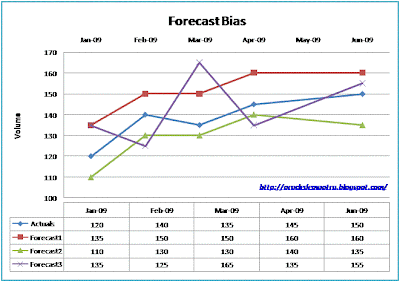
As you would have pointed out already following is the observation on above example:
- Forecast1 has a positive forecast bias
- Forecast2 has a negative forecast bias
- Forecast3 has mixed bias and the cumulative bias in such case could be insignificant
Decision on whether a forecast is biased or not can be made by reviewing the forecast error as well, study the example below.

Why it exists?
As final forecast is combination of statistical forecast and manual intelligent updates, the bias can slide into Final forecast through any of the mentioned input gateways. While statistical forecast bias are normally specific to items(local bias), bias building up due of manual intervention usually has impact on all the items(global bias).
Manual updates done by forecasters/demand planners at times lead to building of a biased forecast. These updates are driven by various factors like:
- Increasing forecast to match up with volume targets
- Optimistic or pessimistic approach towards forecasting
- Expecting Promotional incremental sales volume
This kind of bias usually has impact on all the items.
Bias found in statistical forecast is most of the times under-forecasting or over-forecasting situation for a specific item-location combination. Few of the cases which lead to such observation can be list as:
- Under-forecasting for complete future horizon due of recent months sales volume showing a down trend.
- A persistent trend in sales volume
Such forecast bias is normally particular to an item or an item-customer combination.
Getting rid of Bias?
Bias shall be removed from forecast as it can assist in improving your forecast accuracy, which eventually reflects across supply chain health. An overall reduction on forecast across all items can take out the global bias(e.g. 15% decrement on forecast numbers all across). For bias which is specific to item, one needs to identify and fix them for every incident by adjusting the forecast.
Thursday, February 18, 2010
Fueling supply chain with retailer's POS data - Oracle DSR

When recession hit the market, the impact on CPG industry was inevitable. With customers trying to save every penny possible, the competition in market for providing best quality product at minimal price possible has surpassed all previous levels. Everyone is trying to get the most of every dollar they spend. Few most common CPG industry specific issues can be easily listed as:
- Lost sales due to out of stock conditions
- High inventory carrying cost due of misplaced stocking
- Promotion expenses going in vain
- Loss of margins due of expedition costs
- Increasing IT Complexity
Circumstances like this call for nothing but best in class, efficient and optimized business processes which are driven by one and only goal, increasing the profitable revenue making.
The road to accomplish this target is anything but smooth, need is to ensure that the supply chain backbone transforms into an efficient value chain. The value shall be visible and transparent to every stakeholder, be it an internal department(e.g. sales, marketing, operations) or an external vendor. With growing capabilities at retailer's end to capture demand at the point of it's origin, need is to build processes to capture this demand data and utilize it to drive the supply chain. Problem in gathering and utilizing this information is variety of retailer's POS capturing systems, standards and granularity.
One of the AMR Research paper clearly outlines this fact by saying "The Bottom Line: Consumer products manufacturers must centrally manage all demand signal data, including POS, to create a Demand-Driven Supply Network (DDSN) that improves demand visibility to reduce stockouts by more than half and increase Perfect Order performance by 17%"
While in today's generation of supply chain, availability of data is lowest of concerns, problem is with managing this high volume and ensuring the accurate required information is made available to upstream for planning. With variety of sources of POS data, the need to capture and cleanse it prior to it's availability for being used in planning is of high importance.
Oracle's Demand Signal Repository product has shown thought leadership in this direction, by providing a collaborative demand signal management platform with best of breed functionality and reporting capabilities.

Oracle's DSR datasheet points out it's three key capabilities:
- Capture and manage large volumes of disparate external demand data
- Analyze, report and take action based on Day/SKU/Store level insights
- Integrate clean, harmonized demand data to external applications
DSR empowers you to:
- Greater visibility of data to better sense, shape and respond to demand
- Reduce manual effort and cost
- Simplify collaboration across teams and applications.
(Read more about DSR@ http://www.oracle.com/ocom/groups/public/@ocompublic/documents/webcontent/018927.pdf
Subscribe to:
Posts (Atom)