Showing posts with label SCM - Forecasting. Show all posts

Wednesday, March 13, 2013

Demand Analytics within Oracle, What are my options ??


The need to have access to demand data to capture insights, analyse and respond quickly and appropriately has been around for long in CPG market. The economic turmoil across the globe has added to complexity of projecting demand for CPG goods. Consumers today are spending less and wanting more and better return on their spend dollars. Social media has gone to a new high of usage and is playing a bigger role in consumer's decision making for selecting products. Amount of data present in various forms in various systems is absolutely humongous in size and scale.

Imagine a world where any data which can convey a story about market demand is available for analysis. Though getting every data out there into a system may not be do-able for every business, but atleast having access to key data streams which are classified as indicator for demand can itself be a big step forward. Some of the well known demand indicative elements are POS, Store inventory, Syndicated data, Consumer sentiment captured from big data, etc.

A business intelligence(BI) initiative to capture all such data to gain valuable insight of market/consumers has become critical for CPG companies. Like any BI initiative, few things to keep in mind while embarking a BI project journey are:
  • Never forget that business goal is to gain insights by implementing BI 
  • Thus ensure that these "insights" are identified upfront
We are seeing quite few companies are using Demantra as backbone for forecasting and S&OP process. These companies wish to use data lying in Demantra and S&OP in Oracle BI application for achieving a common reporting center, calling it often Demand Analytics. Building a Demand Analytics layer in your enterprise can help planners, managers and Chief's of company in various ways. Demand Analytics can quickly provide answer to questions like:
  • Which are my most profitable brands?
  • Which customers are giving me most business?
  • How is my newly launched product doing in stores?
  • Where am I running into Out of Stocks and for which products?
  • etc..
Oracle BI apps are already being offered in various areas of business like Mfg Analytics, EAM Analytics, SCOM Analytics etc. For Advanced planning business users community(demand planners, supply planners, demand manager, supply managers, operations manager, S&OP planners and managers, COO, CIO, CFOs etc), Oracle has provided Advanced Planning Command Center and Oracle Demand Signal Repository as two key solutions for planning analytics space.

Oracle DSR: Oracle DSR is more focused towards capturing various demand signals/data from external and internal sources, cleansing and harmonizing it all to report in a BI presentation layer for easy reporting for business. Demand signal repository thus acts as a central warehouse for all demand related information providing business value gained from the insight of demand data in DSR. Also with data elements from DSR integrated to downstream applications like Demantra Demand Management, Demantra Consumer Driven Planning(future release), Demantra PTP, Agile PLM etc, there is richer value which downstream applications and users can realize.
(Read more @ http://www.oracle.com/us/products/applications/ebusiness/planning/053299.html)

Oracle APCC: Advanced Planning Command Center module provides a robust BI analytic layer over Oracle's Value Chain Planning modules, specially ASCP and Demantra. Latest version of APCC allows supply planners to almost do all their day to day ASCP work using simple and better APCC user interface. Additionally APCC allows publishing Demantra DM data as demand plan with option to publish 15 custom forecast&history measures and custom hierarchy into APCC. APCC also support S&OP and IBP processes using demand, supply and financial information from Demantra, SNO and ASCP modules. This module though is more manufacturer's internal operations and planning process centered.
(Read more @ http://www.oracle.com/us/products/applications/ebusiness/planning/053296.html)

A third option which we see clients considering is building a custom VCP Analytic solution using Oracle BI as platform with feeds coming from ASCP, Demantra and other planning applications. This option though is found more common among clients who find Gaps in std APCC offering due of variety of custom sources they may have. If there is lot of ETL work required for feeding APCC with required data from 3rd party sources then considering this 3rd option may become a better choice. Also for clients who already have a strong BI solution footprint are seen to prefer building additional metrics and subject areas on existing analytic solution.

(Read more about OBIEE offering @ http://www.oracle.com/us/solutions/ent-performance-bi/enterprise-edition-066546.html)

Tuesday, February 1, 2011

Few Forecasting Phrases

Forecasting in business is like sex in society, we have to have it, we cannot

get along without it, everyone is doing it, one way or another, but nobody is

sure he is doing it the best way.

-G W Plossl

Last Frontiers for Profits

Forecasting is like trying to drive a car

blindfolded and following directions

given by a person who is looking

out of the back window

- unknown


All forecasts are wrong

Those who claim to forecast the future

are all lying even if, by chance,

they are later proved right .

Tuesday, March 2, 2010

Understanding Forecast Bias


What is bias ?
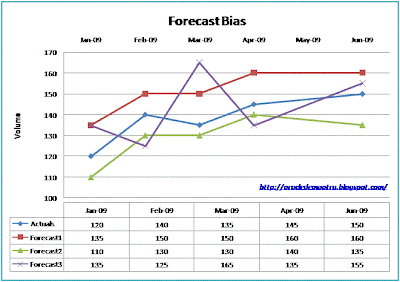
If you observe forecast error going in one direction or other, then you have a forecast which is possibly biased. In the example below try to observe the bias and see if you are able to find the forecast versions with bias.

As you would have pointed out already following is the observation on above example:
  1. Forecast1 has a positive forecast bias
  2. Forecast2 has a negative forecast bias
  3. Forecast3 has mixed bias and the cumulative bias in such case could be insignificant

Decision on whether a forecast is biased or not can be made by reviewing the forecast error as well, study the example below.

Why it exists?
As final forecast is combination of statistical forecast and manual intelligent updates, the bias can slide into Final forecast through any of the mentioned input gateways. While statistical forecast bias are normally specific to items(local bias), bias building up due of manual intervention usually has impact on all the items(global bias).

Manual updates done by forecasters/demand planners at times lead to building of a biased forecast. These updates are driven by various factors like:
- Increasing forecast to match up with volume targets
- Optimistic or pessimistic approach towards forecasting
- Expecting Promotional incremental sales volume
This kind of bias usually has impact on all the items.

Bias found in statistical forecast is most of the times under-forecasting or over-forecasting situation for a specific item-location combination. Few of the cases which lead to such observation can be list as:
- Under-forecasting for complete future horizon due of recent months sales volume showing a down trend.
- A persistent trend in sales volume
Such forecast bias is normally particular to an item or an item-customer combination.

Getting rid of Bias?
Bias shall be removed from forecast as it can assist in improving your forecast accuracy, which eventually reflects across supply chain health. An overall reduction on forecast across all items can take out the global bias(e.g. 15% decrement on forecast numbers all across). For bias which is specific to item, one needs to identify and fix them for every incident by adjusting the forecast.

Wednesday, September 30, 2009

Demand Management Process & Demantra’s Solution

Sensing Demand

Demand data should be collected from various possible sources and which can be treated as “BIBLE” for basing your forecast on. Not only actual sales data but other attributes of sales data like promotional causals, holidays, events etc. should be brought in, which justify the variations in demand data. E.g. Sales data collected from various Retailers’ store varies with days on which store is open, promotions which were launched at the store and competition activities near store’s location. So while predicting sales at these stores we should consider all these factors as well.

Demantra implementation offer real-time Demand sensing capabilities, collect demand data and information from various sources like sales orders, shipments, POS data, distribution center data, customer data and marketing data. Demand can be collected inside Demantra on daily or weekly basis as per the requirements.

Shaping Demand

There are items & locations for which sometime sales data is not available, in that case Demand Planners based on their instincts & experience should be able to enter or edit the sales history. Not only history of sales but forecast numbers generated by engine is likely to be edited to consider inputs which have not been captured by the Analytical Engine.


Oracle Demantra Demand Management provides user ability to define override series for each of collected series and also for forecast series. Demantra provides flexibility to create unlimited number of Causal Factors to capture the information which can describe the demand variance and events which occurred. Causal Factors are created and used to ensure that impacts of these factors are taken into consideration by Engine to generate the Forecast numbers.


Collaboration

For any organization the problem of keeping all the stakeholders who represent various verticals like Manufacturing, Marketing, Sales, Retailers, etc. is very common. Today most of the firms are into global markets and have operations and sales happening in various corners of world. Also to become a demand driven supply chain network, the need of having collaboration with all the demand nodes (e.g., customer’s stores) and supply nodes (e.g., raw material supplier’s factory) becomes vital for most of the industries.

The Demantra application provides an easy to use tool for collaborating with all the stake holders using a web based platform. Users can easily collaborate with their internal stakeholders & customers to better predict their forecast. Also all the stakeholders can be informed and kept in loop to reach to final Consensus Forecast number.


Alerts, Exceptions & Notifications

In most of industrial scenarios it becomes difficult to analyze and to figure out the issues like Demand plan crossing the budget limits, import data failures etc. Thus the automated notifications can assist the planners and managers to take up remedy actions. Alerts can be created within Demantra for notifying stakeholders and concerned group of users on Real-time basis. Automated workflows keep all the users notified and updated if there are any exceptions meeting defined conditions.

Friday, May 22, 2009

Forecasting Basics - revisited

Here is a good presentation on basics of Forecasting....

Wednesday, July 23, 2008

Forecasting Demand vs Sales

One should understand the fact that Demand forecast is not same as Sales forecast and that by utilizing demand forecast rather than sales forecast for planning inventory level can reduce the risk of losing sales by matching the stock with forecasted demand.

On one hand where sales forecast is critical for any retailer for running their business, to make buying decisions and planning operations, it is also important for financial planning. But when retailers follow sales forecast they are not able to meet the actual demand of their merchandise, since they didn’t had the right inventory to meet the consumer demand resulting in lost sales. Also excess inventory for not required item increases the inventory carrying cost and hence eating out your profit.

Planning done based on sales forecast doesn’t capture effects of stocking, where in case of stock out the incoming demand is not converted into sales. Demand of item also decreases due of improper positioning/display of item in shelf; say a particular model of mobile not displayed in shelf might result in low sales of that model. Also in an instance where a competitor launches a new product with similar attributes or in case where there is an event planned to occur for promoting your market, the demand of your item will be impacted. Hence these factors need to be considered when planning is done and should be reflected in forecasted demand.

Forecasting Demand
Demand forecast is more than sales as it not merely represents relation between product and quantity, but also represents effects of pricing, merchandising, promotions, competitor events and other casual factors. Demand forecast includes input from partners, customers and other stakeholders to consider the effect of events and operations outside your territory of planning.

Promotional events effects the demand to a great extent and thus demand planners must take it’s effect on sales while planning. Also various market scenarios impact the demand curve and hence the product sale, proactive response is required for being prepared with proper inventory to exploit the market conditions.

Forecasting Methodology
-Market response based
Business decisions impact in form of market response should be simulated and studied before actual implementations. Ex effect of price change on demand should be analyzed considering price and demand elasticity. Also the impact of market conditions such as display arrangement, competitive offerings and seasonal demand need to be observed and absorbed in demand forecasting methodology.
-Time series based
Time series methods utilize historic happenings and events for future predictions. Based on business conditions suitable method is selected.
Example:
- Holt’s Method : fmcg or basic or staple merchandise
- Winter’s Method : seasonal merchandise
-Croston’s Method : merchandise with lesser turnover
………… ………..
There are more than ten such methods which best suit a particular condition. All these methods learn from historic similar events and model seasonal variation, trend growth or decay, and lifecycle flow.

Sensing Demand
Since time series uses demand history the best pick for gathering this data is from Point Of Sale which is the best source of actual sales information. Adjustments on sales data should be made for full-filing the effect of loss of sales, by adding those extra quantities which would have got sold if it was in stock. Historical demand and related information should be collected from various reliable sources.

Shaping Demand
With knowledge of impact of various promotional and pricing strategies, you will be able to better make decisions in selecting price and promotions. You can align your business objectives with tactical planning options such as what promotions should be launched, when to launch them, in what price band product should be sold etc. Also with information of promotions plan the inventory stocking should be planned to meet that extra demand of right product, thus minimizing over stocks and stock out conditions.

Demand Driven Planning & Execution
The forecasted demand should be utilized by various stakeholders for further planning and execution purpose, to practically operate the demand plan. Business rules and operations should be enacted on for executing the plan so that the forecasted demand is actually converted into sales. Demand intelligence when not executed into the business will not see any fruits too. On the other hand when the same demand intelligence is utilized by the marketing, manufacturing, suppliers and partners for pricing decisions, promotion tactics, inventory planning and stocking purposes, then this all drives to result into intelligent Sales plan.

Perspectives on Managing through Difficult Times